
Your Learning.
Your Skills.
Your Story.
Master any subject or skill. Build your portfolio. Track your learning journey. Empower teachers to personalise learning.
learning
assessments
for the future
teachers
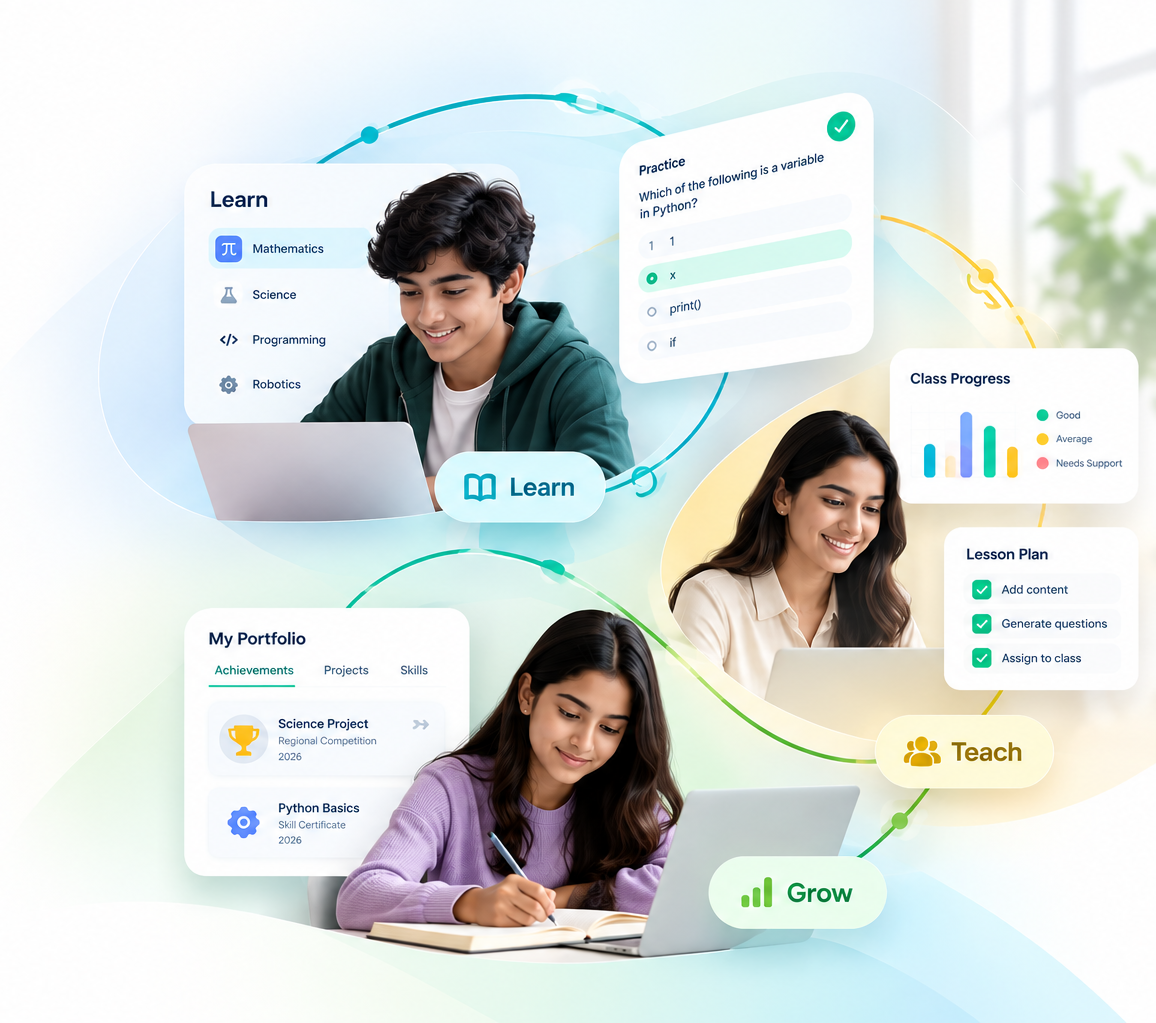
Learn. Practise. Assess. Improve. Master.
Our Intelligent Learning Loop helps you understand concepts, clarify doubts, practise, assess your progress, identify gaps, and keep improving — until you master the topic.
Topic: Cell Structure and Functions
SummaryCore Concepts Summarized
A cell is the basic structural and functional unit of life. All living organisms are made up of cells, which perform essential functions needed for growth, energy production, and survival. Plant and animal cells share several structures, including the cell membrane, cytoplasm, and nucleus, but plant cells also have structures such as a cell wall and chloroplasts.
Cells contain specialized parts called organelles, each performing a specific function. For example, the nucleus controls cell activities, mitochondria release energy from food, and chloroplasts help plant cells prepare food through photosynthesis. Understanding these structures helps explain how living organisms function and survive.
Ready to test yourself?
Which cell part controls cell activities?
Incorrect. The nucleus controls cell activities and contains the genetic material.
MySphere Buddy
Online
Practice assessment Score: 4/5
Hello Prajwal, your overall progress in Science is good, and it’s great to see your consistent effort! You’re showing a strong understanding of Cell Structure, Plant and Animal Cells, and Cell Organelles, including the functions of important cell parts. To take your learning to the next level, focus a little more on Cell Organelles, especially understanding how the nucleus, mitochondria, and chloroplasts perform different functions. Keep practising and you’ll continue to grow!
About
Student passionate about robotics and app development, and keen on eco-friendly projects.
Courses
- Machine LearningRobotics and Me · Beginner
- Arduino Step By StepUdemy · Beginner
Portfolio
Accomplishments
- Winner – Mobile App Development ContestCuriosity Gym · May 2019
Skills
Bite-sized Summaries
Don't get overwhelmed by lengthy texts.
Our AI generates
concise, easy-to-digest summaries of your learning
materials, highlighting the core concepts you need to know.
Apply via Practice
Test your understanding immediately. Engage with interactive practice quizzes.
Ask MySphere Buddy
Stuck on a practice question? Need deeper clarification?
Chat with your AI MySphere Buddy for instant, personalized
guidance and explanations.
Take the Mastery Assessment
Engage with interactive assessments generated dynamically
based on the summary you just read.
Analyse Your Progress
Analyse your progress report feedback.
Act on the recommendations and repeat till you master the topic.
Build Your Portfolio
Showcase your courses, projects and achievements
in one shareable profile that tells your story.
Sharpen your teaching with creativity, personalization and reducing administrative tasks
Create with your edits lesson plans and assessments,autograde, track student class progress, and focus on what matters with personalised feedback.
Lecture Studio
AI PPT GenCreate Assessment
From File: Bio_Ch1.pdf1. Which cell organelle is responsible for ATP production?
2. Which structure controls what enters and leaves the cell?
3. Which organelle is responsible for photosynthesis in plant cells?
Cohort: Grade 10 - Science
Student Insights
Create Lectures
Create stunning presentations from textbook material. Define slide count, language, and topics. AI generates text and images which you can edit to your taste before using in the classroom.
Create Assessments
Upload a textbook and instantly generate MCQs. .Review and edit questions before publishing. Customize fields like marks, time, and scope of chapters, and provide a prompt to customise difficuëty level, or a special focus required.
Class Analytics
Monitor all learners. View practice stats, auto-graded assessments , and download reports. Access AI-generated remarks highlighting individual student strengths and weaknesses.